odd-even classification with LDA classifier
- For CoSMoMVPA's copyright information and license terms, #
- see the COPYING file distributed with CoSMoMVPA. #
Contents
Define data
config = cosmo_config();
data_path = fullfile(config.tutorial_data_path, 'ak6', 's01');

% Load the dataset with VT mask
ds = cosmo_fmri_dataset([data_path '/glm_T_stats_perrun.nii'], ...
                        'mask', [data_path '/vt_mask.nii']);

% remove constant features
ds = cosmo_remove_useless_data(ds);
set sample attributes
ds.sa.targets = repmat((1:6)', 10, 1);
ds.sa.chunks = floor(((1:60) - 1) / 6)' + 1;

% Add labels as sample attributes
classes = {'monkey', 'lemur', 'mallard', 'warbler', 'ladybug', 'lunamoth'};
ds.sa.labels = repmat(classes, 1, 10)';
Part 1: bird classification; train on even runs, test on odd runs
%%%%%%%%%%%%%%%%%%%%%%%%%%%%%%%%%%%%%%%%%%%%%%%%%%%%%%%%%%%%%%%%%%%%%%

% slice into odd and even runs using ds.sa.chunks attribute, and
% store in new dataset structs called 'ds_even' and 'ds_odd'.
% (hint: use the 'mod' function (remainder after division) to see which
% chunks are even or odd)
% >@@>
even_msk = mod(ds.sa.chunks, 2) == 0;
odd_msk = mod(ds.sa.chunks, 2) == 1;

ds_even = cosmo_slice(ds, even_msk);
ds_odd = cosmo_slice(ds, odd_msk);
% <@@<
discriminate between mallards and warblers
categories = {'mallard', 'warbler'};

% select samples where .sa.labels match on of the categories
% for the even and odd runs separately. Slice the dataset twice and store
% the result in 'ds_even_birds' and 'ds_odd_birds'
% (use cosmo_match with .sa.labels and categories to define a mask,
% then cosmo_slice to select the data)
% >@@>
msk_even_birds = cosmo_match(ds_even.sa.labels, categories);
ds_even_birds = cosmo_slice(ds_even, msk_even_birds);

msk_odd_birds = cosmo_match(ds_odd.sa.labels, categories);
ds_odd_birds = cosmo_slice(ds_odd, msk_odd_birds);
% <@@<

% show the data
fprintf('Even data:\n');
cosmo_disp(ds_even_birds);

fprintf('Odd data:\n');
cosmo_disp(ds_odd_birds);

% train on even, test on odd
%
% Use cosmo_classify_lda to get predicted targets for the odd runs when
% training on the even runs, and assign these predictions to
% a variable 'test_pred'.
% (hint: use .samples and .sa.targets from ds_even_birds, and
%        use .samples from ds_odd_birds)
% >@@>
train_samples = ds_even_birds.samples;
train_targets = ds_even_birds.sa.targets;
test_samples = ds_odd_birds.samples;

test_pred = cosmo_classify_lda(train_samples, train_targets, ...
                               test_samples);
% <@@<

% Assign the real targets of the odd runs to a variable 'test_targets'
% >@@>
test_targets = ds_odd_birds.sa.targets;
% <@@<

% show real and predicted labels
fprintf('\ntarget predicted\n');
disp([test_targets test_pred]);

% compare the predicted labels for the odd
% runs with the actual targets to compute the accuracy. Store the accuracy
% in a variable 'accuracy'.
% >@@>
accuracy = mean(test_pred == test_targets);
% <@@<
fprintf('\nLDA birds even-odd: accuracy %.3f\n', accuracy);

% compare with naive bayes classification
% (hint: do classification as above, but use cosmo_classify_naive_bayes)
% >@@>
test_pred_nb = cosmo_classify_naive_bayes(train_samples, train_targets, ...
                                          test_samples);

test_targets = ds_odd_birds.sa.targets;
accuracy = mean(test_pred_nb == test_targets);
% <@@<
fprintf('\nNaive Bayes birds even-odd: accuracy %.3f\n', accuracy);
Even data:
.a
  .vol
    .mat
      [ -3         0         0       121
         0         3         0      -114
         0         0         3     -11.1
         0         0         0         1 ]
    .xform
      'scanner_anat'
    .dim
      [ 80        80        43 ]
  .fdim
    .labels
      { 'i'
        'j'
        'k' }
    .values
      { [ 1         2         3  ...  78        79        80 ]@1x80
        [ 1         2         3  ...  78        79        80 ]@1x80
        [ 1         2         3  ...  41        42        43 ]@1x43 }
.sa
  .targets
    [ 3
      4
      3
      :
      4
      3
      4 ]@10x1
  .chunks
    [  2
       2
       4
       :
       8
      10
      10 ]@10x1
  .labels
    { 'mallard'
      'warbler'
      'mallard'
         :
      'warbler'
      'mallard'
      'warbler' }@10x1
.samples
  [  2.9      1.72      2.76  ...   4.16      2.56      2.95
    1.89      1.37      3.05  ...   4.38      4.46      3.86
    1.26      2.41      2.87  ...   1.96      3.74      3.34
      :         :         :          :          :         :
    2.09      1.53      1.98  ...   3.21      2.94      4.08
    2.13      1.22      2.12  ...    2.3      3.14      1.99
     1.5       1.6      2.07  ...  0.491       1.1      1.78 ]@10x384
.fa
  .i
    [ 32        33        34  ...  28        29        29 ]@1x384
  .j
    [ 24        24        24  ...  25        25        26 ]@1x384
  .k
    [ 3         3         3  ...  9         9         9 ]@1x384
Odd data:
.a
  .vol
    .mat
      [ -3         0         0       121
         0         3         0      -114
         0         0         3     -11.1
         0         0         0         1 ]
    .xform
      'scanner_anat'
    .dim
      [ 80        80        43 ]
  .fdim
    .labels
      { 'i'
        'j'
        'k' }
    .values
      { [ 1         2         3  ...  78        79        80 ]@1x80
        [ 1         2         3  ...  78        79        80 ]@1x80
        [ 1         2         3  ...  41        42        43 ]@1x43 }
.sa
  .targets
    [ 3
      4
      3
      :
      4
      3
      4 ]@10x1
  .chunks
    [ 1
      1
      3
      :
      7
      9
      9 ]@10x1
  .labels
    { 'mallard'
      'warbler'
      'mallard'
         :
      'warbler'
      'mallard'
      'warbler' }@10x1
.samples
  [  1.3     0.646     0.591  ...  1.51      1.75      3.08
    3.08      3.05      4.08  ...  1.88      2.26      2.92
    2.13      2.69      2.99  ...  2.03      2.87      1.74
      :        :         :           :         :         :
    1.47     0.507      1.87  ...  2.59      3.09      3.51
    2.24      2.37      3.27  ...  4.61      2.13      4.32
    1.36      1.31      1.52  ...  2.95      2.61      1.18 ]@10x384
.fa
  .i
    [ 32        33        34  ...  28        29        29 ]@1x384
  .j
    [ 24        24        24  ...  25        25        26 ]@1x384
  .k
    [ 3         3         3  ...  9         9         9 ]@1x384

target predicted
     3     4
     4     4
     3     3
     4     4
     3     3
     4     4
     3     3
     4     4
     3     3
     4     4


LDA birds even-odd: accuracy 0.900

Naive Bayes birds even-odd: accuracy 0.700
Part 2: all categories; train/test on even/odd runs and vice versa
%%%%%%%%%%%%%%%%%%%%%%%%%%%%%%%%%%%%%%%%%%%%%%%%%%%%%%%%%%%%%%%%%%%%%%

% This is as above, but without slicing to get the samples with bird
% species. In other words, just use 'ds_even' and 'ds_odd'
%
% First, train on even, test on odd
% >@@>
train_samples = ds_even.samples;
train_targets = ds_even.sa.targets;
test_samples = ds_odd.samples;

test_pred = cosmo_classify_lda(train_samples, train_targets, test_samples);

test_targets = ds_odd.sa.targets;
accuracy = mean(test_pred == test_targets);
% <@@<
fprintf('\nLDA all categories even-odd: accuracy %.3f\n', accuracy);

% Now train on odd, test on even
% >@@>
train_samples = ds_odd.samples;
train_targets = ds_odd.sa.targets;
test_samples = ds_even.samples;

test_pred = cosmo_classify_lda(train_samples, train_targets, test_samples);

test_targets = ds_even.sa.targets;
accuracy = mean(test_pred == test_targets);
% <@@<
fprintf('\nLDA all categories odd-even: accuracy %.3f\n', accuracy);
LDA all categories even-odd: accuracy 0.767

LDA all categories odd-even: accuracy 0.733
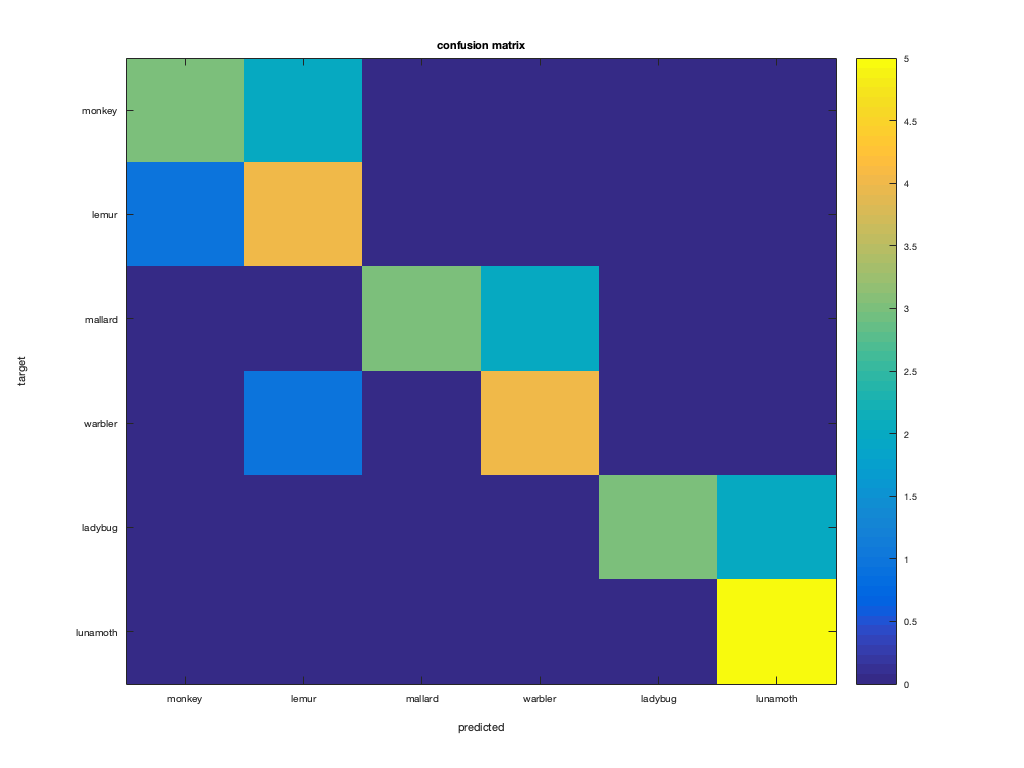
Part 3: build confusion matrix
%%%%%%%%%%%%%%%%%%%%%%%%%%%%%%%%%%%%%%%%%%%%%%%%%%%%%%%%%%%%%%%%%%%%%%

% manually build the confusion matrix for the six categories

% first, allocate space for the confusion matrix
nclasses = numel(classes); % should be 6
confusion_matrix = zeros(nclasses); % 6x6 matrix

% sanity check to ensure targets are in range 1..6
assert(isequal(unique(test_targets), (1:6)'));

% in confusion matrix, the i-th row and j-th column should contain
% the number of times that a sample with test_targets==i was predicted as
% test_pred==j. Use a nested for-loop (a for-loop in a for-loop) to count
% this for all combinations of i (1 to 6) and j (1 to 6)
% >@@>
for predicted = 1:nclasses
    for target = 1:nclasses
        match_mask = test_pred == predicted & test_targets == target;
        match_count = sum(match_mask);
        confusion_matrix(target, predicted) = match_count;
    end
end
% <@@<

% CoSMoMVPA can generate the confusion matrix using cosmo_confusion_matrix;
% the check below ensures that your solution matches the one produced by
% CoSMoMVPA
confusion_matrix_alt = cosmo_confusion_matrix(test_targets, test_pred);
if ~isequal(confusion_matrix, confusion_matrix_alt)
    error('your confusion matrix does not match the expected output');
end

figure;
imagesc(confusion_matrix, [0 5]);
title('confusion matrix');
set(gca, 'XTick', 1:nclasses, 'XTickLabel', classes);
set(gca, 'YTick', 1:nclasses, 'YTickLabel', classes);
ylabel('target');
xlabel('predicted');
colorbar;